3. Set functions, measures and their properties PDF TEX
Set functions and their properties
Finitely and countably additive set functions
Finitely and countably additive set functions. Let \(X\) be a set and let \(\mathcal U \subseteq \mathcal{P}(X)\) be such that \(\varnothing\in \mathcal U\). Let \(\nu:\mathcal U \to [0,\infty]\) be a set function such that \(\nu(\varnothing)=0\). We say that the set function
\(\nu\) is finitely additive on \(\mathcal U\) if for any disjoint finite collection of sets \(A_1,\ldots,A_n\in \mathcal U\) such that \(\bigcup_{j=1}^{n}A_j \in \mathcal U\) we have \[\nu\bigg(\bigcup_{j=1}^{n}A_j\bigg)=\sum_{j=1}^{n}\nu(A_j).\]
\(\nu\) is countably additive on \(\mathcal U\) if for any disjoint countable collection of sets \((A_n)_{n\in \mathbb N}\subseteq \mathcal U\) such that \(\bigcup_{j=1}^{\infty}A_j \in \mathcal U\) we have \[\nu\bigg(\bigcup_{j=1}^{\infty}A_j\bigg)=\sum_{j=1}^{\infty}\nu(A_j).\]
Finitely and countably subadditive set functions
Finitely and countably subadditive set functions. Let \(X\) be a set and let \(\mathcal U \subseteq \mathcal{P}(X)\) be such that \(\varnothing\in \mathcal U\). Let \(\nu:\mathcal U \to [0,\infty]\) be a set function such that \(\nu(\varnothing)=0\). We say that the set function
\(\nu\) is finitely subadditive on \(\mathcal U\) if for any finite collection of sets \(A_1,\ldots,A_n\in \mathcal U\) such that \(\bigcup_{j=1}^{n}A_j \in \mathcal U\) we have \[\nu\bigg(\bigcup_{j=1}^{n}A_j\bigg)\le\sum_{j=1}^{n}\nu(A_j).\]
\(\nu\) is countably subadditive on \(\mathcal U\) if for any countable collection of sets \((A_n)_{n\in \mathbb N}\subseteq \mathcal U\) such that \(\bigcup_{j=1}^{\infty}A_j \in \mathcal U\) we have \[\nu\bigg(\bigcup_{j=1}^{\infty}A_j\bigg)\le\sum_{j=1}^{\infty}\nu(A_j).\]
Some remarks
Remarks. Let \(X\) be a set and let \(\mathcal U \subseteq \mathcal{P}(X)\) be such that \(\varnothing\in \mathcal U\). Let \(\nu:\mathcal U \to [0,\infty]\) be a set function such that \(\nu(\varnothing)=0\).
Then it is easy to see that countable additivity implies finite additivity.
Indeed, if \(A_1,\ldots,A_n\in \mathcal U\) are disjoint such that \(\bigcup_{j=1}^{n}A_j \in \mathcal U\) then one can take \(A_j=\varnothing\) for all \(j>n\) and note that \[\nu(\bigcup_{j=1}^{n}A_j)=\nu(\bigcup_{j=1}^{\infty}A_j)=\sum_{j=1}^{\infty}\nu(A_j)=\sum_{j=1}^{n}\nu(A_j),\] since \(\nu(A_j)=\nu(\varnothing)=0\) for all \(j>n\).
Similar argument shows that countable subadditivity implies finite subadditivity.
From finite to countable additivity
Problem 1. Let \(\mu\) be a finitely additive set function on an algebra of sets \(\mathcal A\) such that \(\mu(A)<\infty\) for every \(A\in\mathcal A\). Prove that the following conditions are equivalent:
(a) the function \(\mu\) is countably additive,
(b) the function \(\mu\) is continuous at zero in the following sense: if \((A_n)_{n\in \mathbb N}\subseteq \mathcal A\) is a decreasing sequence of sets (\(A_{n+1}\subseteq A_n\) for all \(n\in \mathbb N\)) with \(\bigcap_{n\in\mathbb N}A_n=\varnothing\), then \[\lim_{n\to \infty}\mu(A_n)=0.\]
From countable subadditivity to countable additivity
Problem 2. Let \(\rho:\mathcal{E} \to [0,\infty]\) be a set function on a semi-algebra \(\mathcal{E}\) of subsets of a set \(X\) and \(\rho(\varnothing)=0\). Suppose that \(\rho\) is finitely additive on \(\mathcal{E}\) and let \(\mathcal{A}\) be the algebra that consists of all finite disjoint unions of members of \(\mathcal{E}\). Define a set function \(\mu_0\) on \(\mathcal{A}\) by setting \[\mu_0(A)=\sum_{i=1}^{n}\rho(E_i)\] for \(A=\bigcup_{j=1}^{n}E_j \in \mathcal{A}\), where \(E_1,\ldots,E_n \in \mathcal{E}\) and \(E_i \cap E_j = \varnothing\) if \(i \neq j\).
Prove that \(\mu_0\) is a well-defined additive set function on \(\mathcal{A}\) such that \(\mu_0(\varnothing)=0\) and \(\mu_0=\rho\) on \(\mathcal{E}\).
If additionally \(\rho\) is countably subadditive on \(\mathcal{E}\) then prove that \(\mu_0\) is countably additive on \(\mathcal{A}\).
Volume function on \(\mathbb R^d\)
Recall from the previous lecture that the family of all rectangles is given by \[\begin{align*} J^d=J_o^d \cup J_{oc}^d \cup J_{co}^d \cup J^d_c, \end{align*}\] where \(J_o^d, J_{oc}^d, J_{co}^d, J^d_c\), are, respectively, the families of open, open-closed, closed-open, and closed rectangles in \(\mathbb R^d\).
Volume function on \(\mathbb R^d\).
For \(I \in J^d\) we define the volume function \({\rm v}_d:J^d \to [0,\infty]\) by \[{\rm v}_d(I)={\rm vol}_d(I)=\begin{cases} 0&\text{ if } I=\varnothing,\\ \prod_{j=1}^{d}(b_j-a_j) &\text{ if } {\rm cl}(I)=\prod_{j=1}^{d}[a_j, b_j],\\ \infty &\text{ otherwise}. \end{cases}\] For \(d=1\) the volume function \({\rm v}_d\) coincides with the length function on \(\mathbb R\).
The volume function is finitely additive
A union of rectangles is said to be almost disjoint if the interiors of the rectangles are disjoint.
If \(R=\bigcup_{j=1}^nR_j\in J^d\) and \(R_1,\ldots, R_n \in J^d\) are almost disjoint, then \[{\rm v}_d(R)=\sum_{j=1}^n{\rm v}_d(R_j).\]
Proof. We consider the grid formed by extending indefinitely the sides of all rectangles \(R_1,\ldots,R_n\in J^d\).
This extension yields finitely many new rectangles \(\widetilde{R}_1,\ldots,\widetilde{R}_m\in J^d\) and a partition \(J_1,\ldots,J_n\) of the set \(\{1,\ldots, m\}\) such that both unions
\[R=\bigcup_{j=1}^{m}\widetilde{R}_j \quad \text{ and } \quad R_k=\bigcup_{j \in J_k}\widetilde{R}_j \quad \text{ for } \quad k\in\{1,\ldots, n\}\] are almost disjoint.
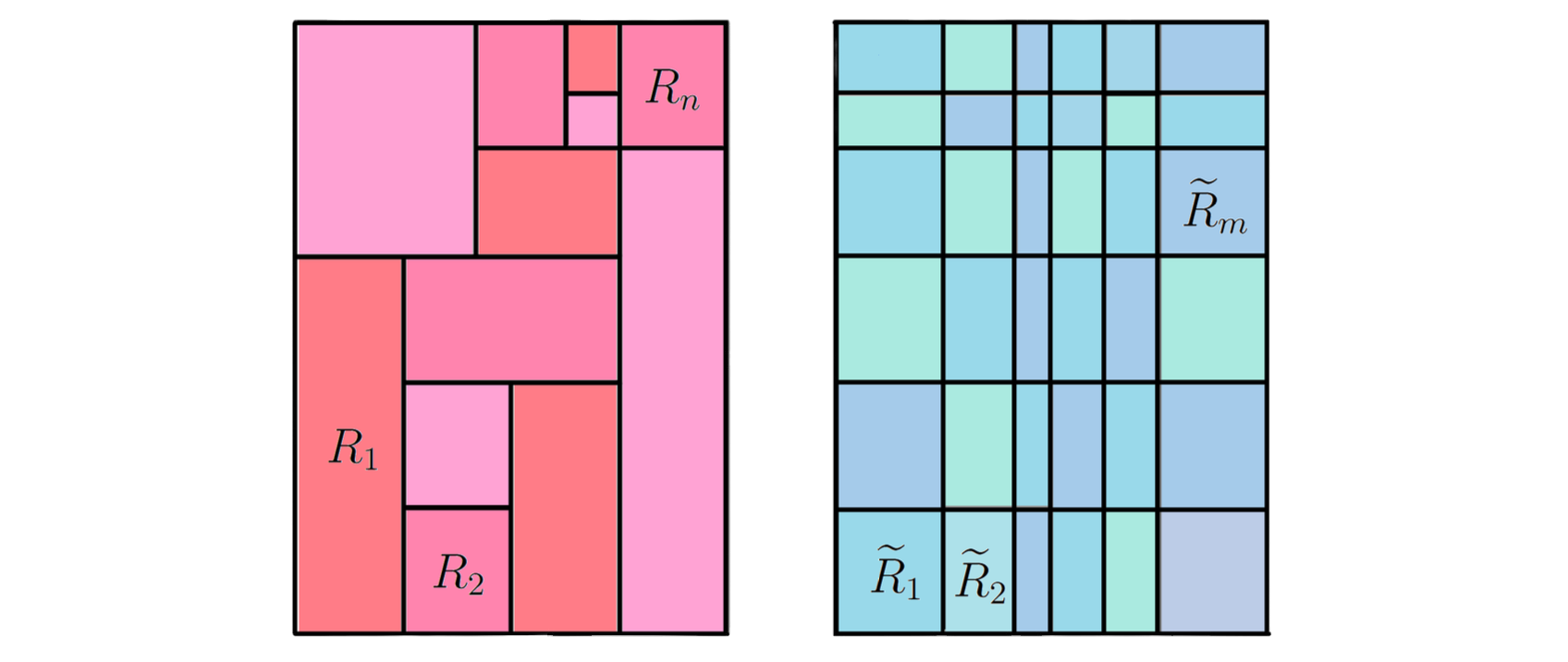
For the rectangle \(R\), for example, we see that \({\rm v}_d(R)=\sum_{j=1}^{m}{\rm v}_d(\widetilde{R}_j)\), since the grid actually partitions the sides of \(R\) and each \(\widetilde{R}_j\) consists of taking products of the intervals in these partitions.
Thus when adding the volumes of the \(\widetilde{R}_j\) we are summing the corresponding products of lengths of the intervals that arise. Since this also holds for the other rectangles \(R_1,\ldots, R_n\) we conclude that \[{\rm v}_d(R)=\sum_{j=1}^m {\rm v}_d(\widetilde{R}_j) =\sum_{k=1}^{n}\sum_{j \in J_k}{\rm v}_d(\widetilde{R}_j) =\sum_{k=1}^{n}{\rm v}_d(R_k). \qquad \]
Problem 3. If \(R=\bigcup_{j=1}^nR_j\in J^d\) and \(R_1,\ldots, R_n \in J^d\) are not necessarily disjoint, then \[{\rm v}_d(R)\le \sum_{j=1}^n{\rm v}_d(R_j).\]
Measures and their properties
Measurable spaces and measure spaces
Measurable space and sets. If \(X\) is a set and \(\mathcal A \subseteq \mathcal{P}(X)\) is a \(\sigma\)-algebra, \((X, \mathcal A)\) is called a measurable space and the sets in \(\mathcal A\) are called measurable sets.
Definition of a measure. Let \((X, \mathcal A)\) be a measurable space. A measure on \(\mathcal A\) (or on \((X, \mathcal A)\), or simply on \(X\) if \(\mathcal A\) is understood) is a function \(\mu:\mathcal A \to [0,\infty]\) such that
\(\mu(\varnothing)=0\),
if \((A_n)_{n\in \mathbb N}\subseteq \mathcal A\) is a sequence of disjoint sets in \(\mathcal A\), then \[\mu\bigg(\bigcup_{j=1}^{\infty}A_j\bigg)=\sum_{j=1}^{\infty}\mu(A_j).\]
Measurable space. If \(\mu\) is a measure on \((X, \mathcal A)\), then \((X,\mathcal A,\mu)\) is called a measure space.
Useful terminology
In other words, a measure \(\mu:\mathcal A \to [0,\infty]\) on a \(\sigma\)-algebra \(\mathcal A\) is a countably additive set function such that \(\mu(\varnothing)=0\).
Terminology. Let \((X,\mathcal A,\mu)\) be a measure space.
If \(\mu(X)<\infty\), \(\mu\) is called finite. This immediately implies that \(\mu(E)<\infty\) for all \(E \in \mathcal A\), since \(\mu(X)=\mu(E)+\mu(E^c)\), .
If \(\mu(X)=1\), \(\mu\) is called probability measure.
If \(X=\bigcup_{j\in\mathbb N} E_j\), where \(E_j \in \mathcal A\) and \(\mu(E_j)<\infty\) for all \(j\in\mathbb N\), \(\mu\) is called \(\sigma\)-finite.
If for each \(E \in \mathcal A\) with \(\mu(E)=\infty\) there exists \(F \in \mathcal A\) with \(F \subseteq E\) and \(0<\mu(F)<\infty\), \(\mu\) is called semifinite.
Examples of measures
Let \(X\neq\varnothing\) and fix \(x_0 \in X\). The Dirac delta measure on \((X, \mathcal{P}(X))\) is defined by \[\delta_{x_0}(E)=\begin{cases} 0 &\text{ if }x_0 \not\in E,\\ 1 &\text{ if }x_0 \in E, \end{cases} \qquad E\subseteq X.\]
Let \(X\neq\varnothing\) be countable. The counting measure on \((X, \mathcal{P}(X))\) is defined by \[\mu(E)=\sum_{x \in X}\delta_{x}(E), \qquad E\subseteq X.\]
Let \(X\) be an infinite set, and define a set function on \((X, \mathcal{P}(X))\) by \[\mu(E)=\begin{cases} \infty &\text{ if }E\text{ is infinite, }\\ 0 &\text{ if }E\text{ is finite, } \end{cases} \qquad E\subseteq X.\] Then \(\mu\) is a finitely additive set function, which is not a measure.
Let \(X\neq\varnothing\) be a finite set. The normalized counting measure on \((X, \mathcal{P}(X))\) is defined by \[\mu(E)=\frac{1}{\#X}\sum_{x \in X}\delta_{x}(E), \qquad E\subseteq X.\] Then \(\mu(X)=1\), which means that \(\mu\) is a probability measure on \(X\).
Problem 4. Let \(X\) be an uncountable set, and let
\[\mathcal A=\{E \subseteq X: E \text{ is countable or } E^c \text{ is countable}\}\] be the algebra of countable or co-countable sets. Define
\[\mu(E)=\begin{cases} 1 &\text{ if }E \text{ is uncountable,}\\ 0 &\text{ otherwise}, \end{cases} \quad E\in \mathcal A.\] Show that \(\mu\) is the measure on \((X, \mathcal A)\).
Basic properties of measures
Theorem. Let \((X,\mathcal A,\mu)\) be a measure space.
(Monotonicity) If \(E,F \in \mathcal A\) and \(E \subseteq F\), then \(\mu(E) \leq \mu(F)\).
(Subadditivity) If \((E_j)_{j\in\mathbb N} \subseteq \mathcal A\), then \(\mu\big(\bigcup_{j=1}^{\infty}E_j\big) \leq \sum_{j=1}^{\infty}\mu(E_j)\).
(Continuity from below) If \((E_j)_{j\in\mathbb N} \subseteq \mathcal A\) and \(E_1 \subseteq E_2 \subseteq \ldots\), then \[\mu\bigg(\bigcup_{n=1}^{\infty}E_n\bigg)=\lim_{n \to \infty}\mu(E_n).\]
(Continuity from above) If \((E_j)_{j\in\mathbb N} \subseteq \mathcal A\) and \(E_1 \supseteq E_2 \supseteq \ldots\) and \(\mu(E_1)<\infty\), then \[\mu\bigg(\bigcap_{n=1}^{\infty}E_n\bigg)=\lim_{n \to \infty}\mu(E_n).\]
Proof of (a). If \(E \subseteq F\), then \[\qquad\qquad \mu(F)=\mu(E)+\mu(F \setminus E) \geq \mu(E). \qquad \qquad\]
Proof of (b). Let \(F_1=E_1\) and \(F_{k+1}=E_{k+1} \setminus \bigcup_{j=1}^{k}E_j\) for \(k\in\mathbb N\). Then \(F_k\)’s are disjoint and \(\bigcup_{j=1}^{n}F_j=\bigcup_{j=1}^{n}E_j\) for all \(n\in\mathbb N\). By (a) we have \[\qquad\mu\bigg(\bigcup_{n=1}^{\infty}E_n\bigg)= \mu\bigg(\bigcup_{n=1}^{\infty}F_n\bigg)=\sum_{n=1}^{\infty}\mu(F_n) \leq \sum_{n=1}^{\infty}\mu(E_n).\qquad \]
Proof of (c). Setting \(E_0=\varnothing\) we obtain \[\mu \bigg(\bigcup_{n=0}^{\infty}E_n\bigg)=\sum_{n=1}^{\infty}\mu(E_n \setminus E_{n-1})=\lim_{n \to \infty}\sum_{j=1}^{n}\mu(E_j \setminus E_{j-1})=\lim_{n \to \infty}\mu(E_n).\]
Proof of (d). Let \(F_j=E_1 \setminus E_j\) for \(j\in\mathbb N\). Then \(F_1 \subseteq F_2 \subseteq \ldots\) and \(\mu(E_1)=\mu(E_j)+\mu(F_j)\), and \[\bigcup_{j=1}^{\infty}F_j=E_1 \setminus \bigcap_{j=1}^{\infty}E_j.\] Then by (c) we conclude \[\begin{align*} \mu(E_1)-\mu\bigg(\bigcap_{j=1}^{\infty}E_j\bigg)&=\mu\bigg(E_1 \setminus \bigcap_{j=1}^{\infty}E_j\bigg) =\mu\bigg(\bigcup_{j=1}^{\infty}F_j\bigg) =\lim_{n \to \infty}\mu(F_n)\\ &=\lim_{n \to \infty}(\mu(E_1)-\mu(E_n)). \end{align*}\] Since \(\mu(E_1)<\infty\) we may subtract it from both sides and we are done.
Problem 5. The assumptions \(\mu(E_1)<\infty\) in (d) cannot be dropped.
Further properties of measures
Problem 6. Let \((X, \mathcal M, \mu)\) be a measure space. If \((E_j)_{j\in\mathbb N}\subseteq\mathcal M\) and \(\mu(E_m\cap E_n)=0\) for every \(m\neq n\), prove that \[\mu\big(\bigcup_{j\in\mathbb N}E_j\big)=\sum_{j\in\mathbb N}\mu(E_j).\]
Problem 7. Let \((X, \mathcal M)\) be a measurable space and \(\mathcal A\) an algebra of sets such that \(\sigma(\mathcal A) = \mathcal M\). Suppose \(\mu_1\) and \(\mu_2\) are finite measures on \((X, \mathcal M)\) such that \(\mu_1(A)=\mu_2(A)\) for every \(A\in \mathcal A\). Show that \[\mu_1(A)=\mu_2(A)\] for every \(A\in \mathcal M\).
Null sets \(\equiv\) negligible sets \(\equiv\) sets of measure zero
Null sets. If \((X, \mathcal A, \mu)\) is a measure space, a set \(E\in \mathcal A\) such that \(\mu(E)=0\) is called a null set. By subadditivity any countable union of null sets is a null set.
Almost everywhere. If a statement about points \(x \in X\) is true except for \(x\) in some null set, we say that it is true \(\mu\)-almost everywhere (abbreviated \(\mu\)-a.e.), or for \(\mu\)-almost every \(x\).
Remark. If \(E\in \mathcal A\) and \(\mu(E)=0\) and \(F \subseteq E\), then \(\mu(F)=0\) by monotonicity of \(\mu\) provided that \(F\in \mathcal A\). In general, it need not to be true that \(F \in \mathcal A\).
Complete measure. A measure whose domain includes all subsets of null sets is called complete.
Completion of \(\sigma\)-algebras
Theorem. Suppose that \((X,\mathcal A, \mu)\) is a measure space. Let \[\mathcal{N}=\{N \in \mathcal A : \mu(N)=0\},\] and \[\overline{\mathcal{A}}=\{E \cup F : E \in \mathcal A \text{ and } F \subseteq N \text{ for some } N \in \mathcal{N}\}.\] Then
\(\overline{\mathcal{A}}\) is a \(\sigma\)-algebra.
There is a unique extension \(\bar{\mu}\) of \(\mu\) to a complete measure on \(\overline{\mathcal{A}}\).
Proof of (a): Since \(\mathcal A\) and \(\mathcal N\) are closed under countable unions, so is \(\overline{\mathcal{A}}\). We show that \((E \cup F) ^c\in \overline{\mathcal{A}}\), if \(E \cup F \in \overline{\mathcal{A}}\), where \(E \in \mathcal{A}\) and \(F\subseteq N \in \mathcal{N}\). This will show that \(\overline{\mathcal{A}}\) is a \(\sigma\)-algebra and the proof of (a) will be completed.
We can assume that \(E \cap N=\varnothing\) (otherwise we replace \(F\) and \(N\) by \(F \setminus E\) and \(N \setminus E\)). Then \(E \cup F = (E \cup N) \cap (N^c \cup F),\) so \[(E \cup F)^c = (E \cup N)^c \cup (N \setminus F).\] But \((E \cup N)^c \in \mathcal A\) and \(N \setminus F \subseteq N\), so that \((E \cup F)^c \in \overline{\mathcal{A}}\). So \(\overline{\mathcal{A}}\) is a \(\sigma\)-algebra as desired.
Proof of (b): (Construction of \(\bar{\mu}\)). For \(E \cup F \in \overline{\mathcal{A}}\), we set \[\bar{\mu}(E \cup F)=\mu(E).\] This new measure \(\bar{\mu}\) is well defined. Indeed, if \(E_1 \cup F_1=E_2 \cup F_2\), where \(F_j \subseteq N_j \in \mathcal{N}\) for \(i=1, 2\), then \(E_1 \subseteq E_2 \cup N_2\) and so \[\mu(E_1) \leq \mu(E_2) +\mu(N_2)=\mu(E_2),\] and likewise \(\mu(E_2) \leq \mu(E_1)\). Thus \(\bar{\mu}(E_1 \cup F_1)=\bar{\mu}(E_2 \cup F_2)\) as claimed.
Proof of (b): (Completeness of \(\bar{\mu}\)). If \(E \in \overline{\mathcal{A}}\) and \(\bar{\mu}(E)=0\) then we show that for any \(E_0 \subseteq E\) we have \(\bar{\mu}(E_0)=0\) and \(E_0 \in \overline{\mathcal{A}}\). Let \(E=A \cup C\), where \(A \in {\mathcal{A}}\) and \(C \subseteq N\in \mathcal{N}\) and \(\mu(N)=0\). Note that \[0=\bar{\mu}(E)={\mu}(A).\] Thus \(A \in \mathcal{N}\) and consequently \(E_0 \subseteq E=A \cup C \subseteq A \cup N\in \mathcal{N}\), which yields that \(E_0 \in \overline{\mathcal{A}}\) and \(\bar{\mu}(E_0)=\mu(\varnothing)=0\).
Proof of (b): (Uniqueness of \(\bar{\mu}\)). Let \((X, \mathcal M,\nu)\) be a complete measure space such that \(\mathcal M\supseteq\overline{\mathcal{A}}\) and \(\nu(E)=\mu(E)\) for all \(E \in \mathcal A\), then we show that \(\nu=\bar{\mu}\) on \(\overline{\mathcal{A}}\). Indeed, suppose that \(E \in \overline{\mathcal{A}}\), where \(E=A \cup F\) and \(F \subseteq N \in \mathcal{N}\) and \(\mu(N)=0\). We may write \(E=A \cup F=A \cup (F \setminus A)\), and \(F \setminus A \subseteq F \subseteq N \in \mathcal{N}\). Hence \[\bar{\mu}(E)=\bar{\mu}(A \cup (F \setminus A))=\mu(A)=\nu(A)=\nu(A)+\nu(F \setminus A)=\nu(E),\] since \(F \setminus A\in\mathcal M\) and \(\nu(F \setminus A)=0\). Thus \(\nu=\bar{\mu}\) on \(\overline{\mathcal{A}}\).
Nonatomic measure spaces
Nonatomic measure space. We say that a measure space \((X, \mathcal M, \mu)\) is nonatomic if for every \(A \in \mathcal M\) with \(\mu(A)>0\) there exists \(B \in \mathcal M\) such that \[B \subseteq A \quad \text{ and } \quad 0<\mu(B)<\mu(A).\]
Problem 8. Let \((X, \mathcal M, \mu)\) be a nonatomic finite measure space. Show that for every \(\varepsilon>0\) and every \(A \in \mathcal M\) with \(\mu(A)>0\) there exists \(B \in \mathcal M\) such that \[B \subseteq A \quad \text{ and } \quad 0<\mu(B)<\varepsilon.\]
Nonatomic measure spaces attain all intermediate values
Problem 9. Let \((X, \mathcal M, \mu)\) be a nonatomic finite measure space. Show that for every \(A \in \mathcal M\) and every \(\theta \in [0, \mu(A)]\) there exists \(B \in \mathcal M\) such that \[B \subseteq A \quad \text{ and } \quad \mu(B)=\theta.\]
Hint.
Inductively define the collections \(\mathcal H_n\), the numbers \(h_n\) and the sets \(H_n\) as follows. Set \(H_0=\varnothing\) and \(\mathcal H_0=\{\varnothing\}\), and for \(n \in \mathbb N\) let
\[\mathcal H_n=\Big\{H \in \mathcal M\colon H \subseteq A \setminus \bigcup_{k=0}^{n-1}H_k \ \text{ and } \ \mu\Big(\bigcup_{k=0}^{n-1}H_k\Big)+\mu(H) \leq \theta\Big\},\] \[h_n=\sup\{\mu(H)\colon H \in \mathcal H_n\},\] and choose \(H_n \in \mathcal H_n\) such that \(\mu(H_n) \geq h_n-\min\Big\{h_n, \frac{1}{n}\Big\}.\) Finally, consider the set \(\bigcup_{n \in \mathbb N}H_n\).
Regularity of finite Borel measures
Borel measures. Let \(X\) be a topological space. A measure \(\mu\) defined on a Borel \(\sigma\)-algebra \({\rm Bor}(X)\) is called a Borel measure. A pair \((X, {\rm Bor}(X))\) is called a Borel space, whereas a triple \((X, {\rm Bor}(X), \mu)\) is called a Borel measure space.
Problem 10. Let \(X\) be a metric space and let \((X, {\rm Bor}(X), \mu)\) be a finite Borel measure space. Show that \[{\rm Bor}(X)=\mathcal M,\] where \[\begin{align*} \mathcal M=\Big\{B \in {\rm Bor}(X): \mu(B)=&\sup\{\mu(F): F \subseteq B \text{ and } F \text{ closed}\}\\ & =\inf\{\mu(U): U \supseteq B \text{ and } U \text{ open}\}\Big\}. \end{align*}\]