6. Cantor set and Cantor function; Nonmeasurable sets and Kakeya sets PDF TEX
Some properties of Lebesgue measure
Some properties of Lebesgue measure
Let \(\lambda\) be the Lebesgue measure on \(\mathbb{R}\). Then we have
\(\lambda(\{x\})=0\) for any \(x \in \mathbb{R}\),
\(\mathbb{Q}\) has Lebesgue measure \(0\). In fact, \(\lambda(U)=0\) for any countable set \(U \subseteq \mathbb{R}\),
If \(U\) is open in \(\mathbb{R}\), then \(\lambda(U)>0\),
If \(E\) is a null set in \(\mathbb{R}\) (i.e. \(\lambda(E)=0\)) then \(E^c\) is dense in \(\mathbb{R}\).
Proof. For any open interval \(I \subseteq \mathbb{R}\) we have \(\lambda(I)>0\). Since \(\lambda(E)=0\) this means that \(E\) cannot contain any open interval. Thus \(E^c \cap I \neq \varnothing\) for any interval \(I \subseteq \mathbb{R}\) but this means that \(E^c\) is dense in \(\mathbb{R}.\)
Nowhere dense set with positive Lebesgue measure
5. Let \(\mathbb{Q} \cap [0,1]=\{r_j: j \in \mathbb{N}\}\) and given \(\varepsilon>0\) let \(I_j\) be the open interval of length \(\varepsilon2^{-j}\), which is centered at \(r_j\). Then the set \[U=(0,1) \cap \bigcup_{j=1}^{\infty}I_j\] is open and dense in \(\mathbb{R}\), since \(U \supseteq \mathbb{Q} \cap (0,1)\). Thus \(U\) is topologically large but small in the sense of measure, since \[\lambda(U) \leq \sum_{j=1}^{\infty}\lambda(I_j) \leq \sum_{j=1}^{\infty}\frac{\varepsilon}{2^j}=\varepsilon.\]
6. If \(K=[0,1] \setminus U\) then \(K\) is closed and nowhere dense thus topologically small but large in the sense of measure since \[\lambda(K)=1-\lambda(U) \geq 1-\varepsilon.\]
Cantor set
Accumulation point, isolated point, perfect set
Accumulation point. Let \((X,\rho)\) be a metric space, \(x \in X\) is called an accumulation point of \(E \subseteq X\) if for every open set \(U \ni x\) we have \[(E \setminus \{x\}) \cap U \neq \varnothing.\]
An accumulation point \(x\) of \(E \subseteq X\) is sometimes also called a limit point of \(E\) or a cluster point of \(E\).
Isolated point. A point \(x \in E\) is called an isolated point of \(E\) if it is not an accumulation point of \(E\).
Perfect sets. We say that a subset \(E\) of a metric space \((X,\rho)\) is perfect if \(E\) is closed and every point of \(E\) is its limit point.
There exists a perfect set in \(\mathbb{R}\) which contains no segment.
Let \(C_0=[0,1]\). Given \(C_n\) that consists of \(2^n\) disjoint closed intervals each of length \(3^{-n}\) take each of these intervals and delete the open middle third to produce two closed intervals each of length \(3^{-n-1}\).
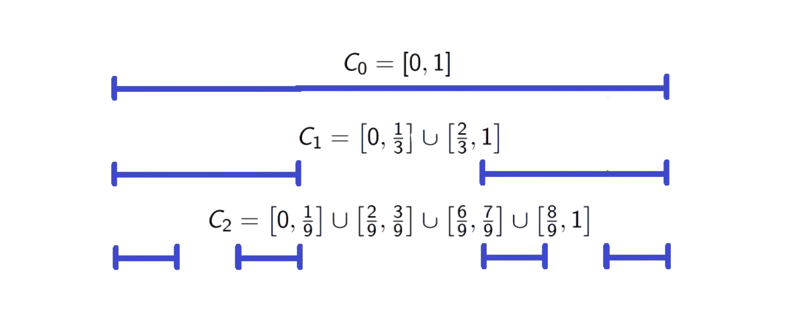
Take \(C_{n+1}\) to be the union of \(2^{n+1}\) closed intervals so formed and continue.
Cantor set
Cantor set. The set \[\mathcal{C}=\bigcap_{n=0}^{\infty}C_n\] is called the Cantor set or ternary Cantor set.
Each \(C_0 \supseteq C_1 \supseteq C_2 \supseteq \ldots\) is closed and bounded thus compact, and the family \((C_n)_{n \in \mathbb{N}}\) has finite intersection property thus the Cantor set is compact and \(\mathcal{C} \neq \varnothing\) .
Property (*). By the construction for each \(k,m \in \mathbb{N}\) we see that \[\left(\frac{3k+1}{3^m},\frac{3k+2}{3^m}\right)\cap \mathcal{C}=\varnothing.\]
Properties of the Cantor set
Every segment \((\alpha,\beta)\) contains a segment of the form (*) if \(m\) is sufficiently large, since the set \[\left\{\frac{\ell}{3^m}: m \in \mathbb{N} \text{ and }0 \leq \ell \leq 3^{m}-1\right\}\] is dense in \([0,1]\). Thus \(\mathcal{C}\) contains no segment \((\alpha,\beta)\). This also shows that \({\rm int\;}\mathcal C=\varnothing\).
To prove that \(\mathcal{C}\) is perfect it is enough to show that \(\mathcal{C}\) contains no isolated points. Let \(x \in \mathcal{C}\) and let \(I_n\) be the unique interval from \(C_n\) which contains \(x \in I_n\). Let \(x_n\) be the endpoint of \(I_n\) such that \(x \neq x_n\). It follows from the construction of \(\mathcal{C}\) that \(x_n \in \mathcal{C}\). Hence \(x\) is a limit point of \(\mathcal{C}\) thus \(\mathcal{C}\) is perfect.
More about Cantor set
Cantor set has Lebesgue measure zero
We have \[\lambda(\mathcal C)=0.\]
Indeed, by the construction note that \[\mathcal{C}=\bigcap_{n=0}^{\infty}C_n\] and \[\lambda(C_n)=\bigg(\frac{2}{3}\bigg)^n \quad \text{ for any } \quad n\in\mathbb N.\] By the continuity of \(\lambda\), since \(C_0 \supseteq C_1 \supseteq C_2 \supseteq \ldots\) and \(\lambda(C_0)=1\), we have \[\lambda(\mathcal C)=\lim_{n\to \infty}\lambda(C_n)=\lim_{n\to \infty}\bigg(\frac{2}{3}\bigg)^n=0.\]
More about Cantor set
Each component of \(C_n\) can be described as the set
\[C_n=\left\{\sum_{n=1}^\infty \frac{\varepsilon_j}{3^j}\;:\; \varepsilon_j \in \{0,1,2\} \text{ and }\varepsilon_j \neq 1 \text{ for }1 \leq j \leq n\right\}.\].
Consequently,
\[{\color{teal}\mathcal{C}=\left\{\sum_{n=1}^\infty \frac{\varepsilon_j}{3^j}\;:\; \varepsilon_j \in \{0,2\} \right\}.}\].
Fact
Fact. Any number \(\sum_{j=1}^\infty \frac{\varepsilon_j}{3^j}\) is uniquely determined by its sequence \(\varepsilon=(\varepsilon_j)_{j \in \mathbb{N}}\) with \(\varepsilon_j \in \{0,2\}\).
Proof. Take \(\varepsilon=(\varepsilon_j)_{j \in \mathbb{N}}\), \(\delta=(\delta_j)_{j \in \mathbb{N}}\) with \(\varepsilon_j,\delta_j \in \{0,2\}\) such that \(\varepsilon \neq \delta\). Let \(N=\min\{j \in \mathbb{N}\;:\; \varepsilon_j \neq \delta_j\}\) and assume \(0=\varepsilon_N<\delta_N=2\). Then \[\begin{align*} \sum_{j=1}^{\infty}\frac{\varepsilon_j}{3^j}&= \sum_{j=1}^{N-1}\frac{\varepsilon_j}{3^j}+\sum_{j=N+1}^{\infty}\frac{\varepsilon_j}{3^j} \leq \sum_{j=1}^{N-1}\frac{\delta_j}{3^j}+\frac{2}{3^{N+1}}\sum_{j=0}^{\infty}\frac{1}{3^j} \\&\leq \sum_{j=1}^{N-1}\frac{\delta_j}{3^j}+\frac{2}{3^{N+1}}\underbrace{\frac{1}{1-\frac{1}{3}}}_{{\color{red}\frac{3}{2}}} =\sum_{j=1}^{N-1}\frac{\delta_j}{3^j}+\frac{1}{3^N}<\sum_{j=1}^{N-1}\frac{\delta_j}{3^j}+\frac{2}{3^N}\le \sum_{j=1}^{\infty}\frac{\delta_j}{3^j}. \end{align*}\] This completes the proof.
Remarks
Remark. We have two different representations \[\begin{align*} \frac{1}{3}&=\sum_{j=1}^\infty \frac{\varepsilon_j}{3^j}=A, \quad \varepsilon_1=1, \quad \varepsilon_j=0 \quad\text{ for } \quad j \geq 2.\\ \frac{1}{3}&=\sum_{j=1}^\infty \frac{\varepsilon_j}{3^j}=B, \quad \varepsilon_1=0, \quad \varepsilon_j=2 \quad \text{ for } \quad j \geq 2. \end{align*}\]
There is a bijection \(\phi:\{0,1\}^{\mathbb{N}} \to \mathcal{C}\) defined by \[\phi(z)=\frac{2}{3}\sum_{j=0}^{\infty}\frac{z_j}{3^j} \quad \text{ for } \quad z=(z_j)_{j \in \mathbb{N}}, \quad z_j \in \{0,1\},\] and consequently \({\rm card\;}(\mathcal{C})={\rm card\;}(\{0,1\}^{\mathbb{N}})={\rm card\;}(\mathbb{R})=\mathfrak{c}.\)
Cantor tree
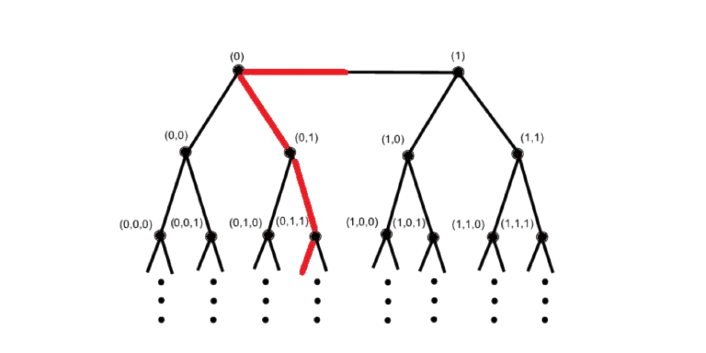
\({\color{red}\varepsilon=(0,1,1,0,\varepsilon_4,\varepsilon_5,\ldots)}\)
Cantor–Lebesgue function
Cantor–Lebesgue approximating function. For each \(n \in \mathbb{N}\) and \(x\in[0, 1]\) we define \[f_n(x)=\left(\frac{3}{2}\right)^n\lambda(C_n\cap[0, x]).\]
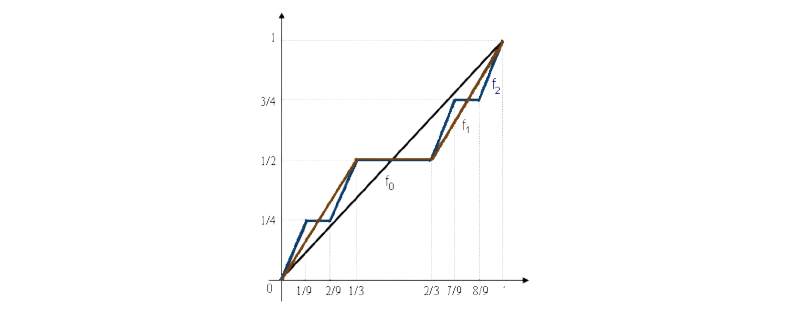
Because \(C_n\) is a finite union of intervals, \[f_n(x)=\left(\frac{3}{2}\right)^n\lambda(C_n\cap[0, x]).\] is a polygonal function with \(f_n(0)=0\), \(f_n(1)=1\), and \(f_n\) is constant on each of \(2^{n}-1\) open intervals composing \([0,1] \setminus C_n\) and rises with slope \(\left(\frac{3}{2}\right)^n\) on each on the \(2^n\) closed intervals composing \(C_n\).
If the \(j\)-th interval of \(C_n\) counting from the left is \([a_{n,j},b_{n,j}]\), then \[f_n(a_{n,j})=\frac{j-1}{2^n} \quad \text{ and } \quad f_n(b_{n,j})=\frac{j}{2^n}.\] Also \(a_{n,j}=a_{n+1, 2j-1}\) and \(b_{n, j}=b_{n+1, 2j}\) and \[f_{n+1}(a_{n, j})=f_{n}(a_{n, j}) \quad \text{ and } \quad f_{n+1}(b_{n, j})=f_{n}(b_{n, j})\] and \(f_{n+1}\) agrees with \(f_n\) at all of the endpoints of the intervals of \(C_n\) and therefore on \([0,1] \setminus C_n\).
Within any particular interval \([a_{n,j},b_{n,j}]\) of \(C_n\) the greatest difference between \(f_n(x)\) and \(f_{n+1}(x)\) is at the new endpoints within that interval and the magnitude of the difference is at most \(\frac{1}{6 \cdot 2^n}\). Thus we have \[|f_{n+1}(x)-f_n(x)| \leq \frac{1}{6 \cdot 2^n} \quad \text{ for any } \quad n \in \mathbb{N}.\]
Since \[\frac{1}{6}\sum_{n \in \mathbb{N}}\frac{1}{2^n}<\infty.\] thus \((f_n)_{n \in \mathbb{N}}\) is uniformly convergent to a continuous function \(f:[0,1] \to [0,1].\)
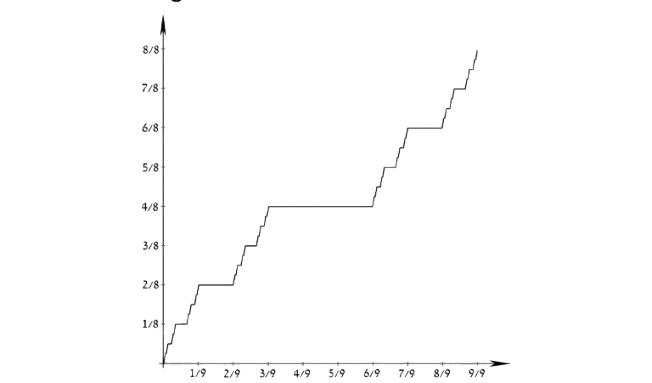
This function is called the Cantor–Lebesgue function or Devil’s staircase function.
The Cantor–Lebesgue function or Devil’s staircase function:
Properties of the Cantor–Lebesgue function
Every \(f_n\) is non-decreasing so is \(f\).
Let \(\phi:\{0,1\}^{\mathbb{N}} \to \mathcal{C}\), be given by \[\phi(z)=\frac{2}{3}\sum_{j=0}^{\infty}\frac{z_j}{3^j}\] for every \(z=(z_j)_{j \in \mathbb{N}} \in \{0,1\}^{\mathbb{N}}\). Then \[f(\phi(z))=\frac{1}{2}\sum_{j=0}^{\infty}\frac{z_j}{2^j}.\]
Indeed, fix \(\eta=\{\eta_0,\eta_1,\ldots\} \in \{0,1\}^{\mathbb{N}}\) and for each \(n \in \mathbb{N}\) take \(I_n\) to be the component of \(C_n\) containing \(\phi(\eta)\). Then \(I_{n+1}\) will be the left-hand third of \(I_{n+1}\) if \(\eta_n=0\) and the right-hand third if \(\eta_n=1\).
Taking \(a_n\) to be the left-hand endpoint of \(I_n\) we see that \[a_{n+1}=a_{n}+\frac{2}{3}\cdot\frac{\eta_n}{3^{n}} \quad\text{ and }\quad f_{n+1}(a_{n+1})=f_n(a_n)+\frac{1}{2}\cdot \frac{\eta_n}{2^{n}}\] for each \(n\in\mathbb N\). Thus \[\phi(\eta)=\lim_{n \to \infty}a_n\] and \[f(\phi(z))=\lim_{n \to \infty}f_n(a_n)=\frac{1}{2}\sum_{j=0}^{\infty}\frac{\eta_j}{2^j}.\]
In particular, \(f[\mathcal{C}]=[0,1]\) since any \(x\in[0, 1]\) is expressible as \[x=\sum_{j=0}^{\infty}\frac{\eta_j}{2^{j+1}}=f(\phi(\eta))\] for some \(z =(z_j)_{j \in \mathbb{N}} \in \{0,1\}^{\mathbb{N}}\).
The axiom of choice
The axiom of choice. If \((X_{\alpha})_{\alpha \in A}\) is a nonempty collection of nonempty sets, then \[\prod_{\alpha \in A}X_{\alpha} \neq \varnothing.\]
Corollary. If \((X_{\alpha})_{\alpha \in A}\) is a disjoint collection of nonempty sets, then there is a set \(Y \subseteq \bigcup_{\alpha \in A}X_{\alpha}\) (called the selector of \((X_{\alpha})_{\alpha \in A}\)) such that \(Y \cap X_{\alpha}\) contains precisely one element for each \(\alpha \in A\).
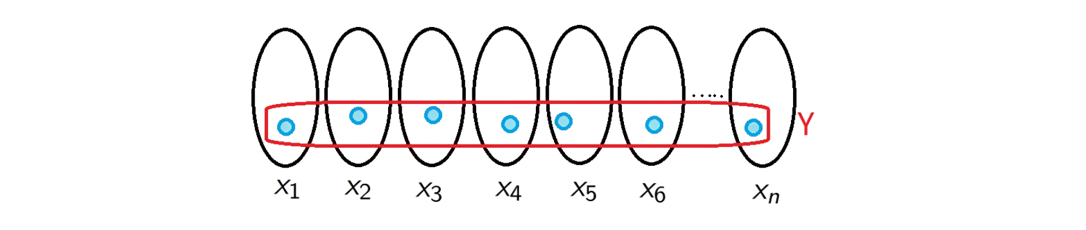
Proof.
Take \(f \in \prod_{\alpha \in A}X_{\alpha} \neq \varnothing\). Define \[Y=f[A],\] then \[Y \cap X_{\alpha}=\{f(\alpha)\}\] since \(f(\alpha) \in X_{\alpha}\).
Nonmeasurable sets
Some equivalence relation
Equivalence relation. We write \(x \sim y\) iff \(x-y \in \mathbb{Q}\). This is an equivalence relation:
\(x \sim x\), since \(x-x=0 \in \mathbb{Q}\) for any \(x \in [0,1]\),
if \(x \sim y\), then \(y \sim x\),
if \(x \sim y\) and \(y \sim z\), then \(x \sim z\).
Let \(\{\epsilon_{\alpha}: \alpha\in A\}\) be the set of all equivalence classes. The equivalence classes \(\epsilon_{\alpha}\) are either disjoint or coincide, and \([0,1]\) is the disjoint union of all equivalence classes, we write \[[0,1]=\bigcup_{\alpha \in A}\epsilon_\alpha,\] and \[\epsilon_\alpha \cap \epsilon_\beta=\varnothing \quad \text{ if } \quad \alpha \neq \beta.\]
Nonmeasurable subset of \(\mathbb R\)
Vitali’s Theorem. There exists a nonmeasurable subset of \(\mathbb{R}\).
Proof. Since \([0,1]=\bigcup_{\alpha \in A}\epsilon_\alpha\), by the axiom of choice there is a selector \[\mathcal{N}=\{x_{\alpha}: \alpha \in A\}\] for the family \((\epsilon_\alpha)_{\alpha \in A}\) such that \[{\rm card\;}(\mathcal{N} \cap \epsilon_{\alpha})=1 \quad \text{ for any }\quad \alpha \in A\] We claim that the set \(\mathcal{N}\) is non-measurable.
Let \(\{r_k: k \in \mathbb{N}\}=\mathbb{Q} \cap [0,1]\). For each \(k \in \mathbb{N}\) consider \[\mathcal{N}_k=r_k+\mathcal{N}.\]
We show that
\(\mathcal{N}_k \cap \mathcal{N}_l = \varnothing\) if \(k \neq l\),
\([0,1] \subseteq \bigcup_{k=1}^{\infty}\mathcal{N}_k \subseteq [-1,2]\).
Proof of (i). If \(\mathcal{N}_k \cap \mathcal{N}_l \neq \varnothing\) for some \(l \neq k\), then there are \(\alpha,\beta\in A\) and \(r_k \neq r_l\) such that \[x_{\alpha}+r_k=x_{\beta}+r_l \iff x_{\alpha}-x_{\beta}=r_l-r_k.\] Consequently, \(\alpha \neq \beta\) and \(x_{\alpha} - x_{\beta}\in \mathbb{Q}\). Hence, \(x_{\alpha} \sim x_{\beta}\). But this contradicts the fact that \(\mathcal{N}\) contains only one representative of each equivalence class.
Proof of (ii). Of course \(\bigcup_{k=1}^{\infty}\mathcal{N}_k \subseteq [-1,2]\). If \(x \in [0,1]\) then \(x \sim x_{\alpha}\) for some \(\alpha \in A\) and \(x-x_{\alpha}=r_k\) for some \(k \in \mathbb{N}\) thus \[x=x_\alpha+r_k \in r_k+\mathcal{N}=\mathcal{N}_k.\]
If we assume that \(\mathcal{N}\) is measurable then \[\begin{align*} \lambda(\mathcal{N})=\lambda(r_k+\mathcal{N})=\lambda(\mathcal{N}_k) \quad \text{ for all } \quad k \in \mathbb{N}, \end{align*}\] by the translation invariance of Lebesgue measure. Now note that \[\begin{align*} 1=\lambda([0,1]) &\leq \lambda\bigg(\bigcup_{k=1}^{\infty}\mathcal{N}_k\bigg)\\ &=\sum_{k=1}^{\infty}\lambda(\mathcal{N}_k) \\ &\leq \lambda([-1,2])=3. \end{align*}\]
This is a contradiction since neither \(\lambda(\mathcal{N})=0\) nor \(\lambda(\mathcal{N})=1\).
Kakeya sets
Kakeya sets
Definition. A set \(\mathcal K \subseteq \mathbb R^d\) is called a Kakeya set (or a Besicovitch set) if it contains a unit line segment in every direction, that is, for every \(e \in \mathbb R^d\) with length one, i.e. \(|e|=1\), there exists \(y \in \mathbb R^d\) such that \[\{y+te: t \in [0,1]\} \subseteq \mathcal K.\]
In 1917 Kakeya asked for the smallest area of a region in the plane inside which a unit needle can be rotated by \(180^{\circ}\).
Besicovitch proved in 1919 that there exist Kakeya sets in \(\mathbb R^2\) of Lebesgue measure zero, so no smallest area exists.
Such sets are nevertheless large in the sense of Lecture 4: the Kakeya conjecture asserts that every Kakeya set in \(\mathbb R^d\) has Hausdorff dimension \(d\). This is classical for \(d=2\) and was recently proved for \(d=3\) by Wang and Zahl.
Bishop’s construction of a Kakeya set in \(\mathbb R^2\)
Theorem. There exists a compact Kakeya set in \(\mathbb R^2\) of Lebesgue measure zero.
Proof:
The construction below produces a compact set \(\mathcal K \subseteq \mathbb R^2\) with \(\lambda_2(\mathcal K)=0\) which contains a unit segment of every slope in \([0,1]\).
The union of four copies of \(\mathcal K\) rotated by \(0, \frac{\pi}{4}, \frac{\pi}{2}\) and \(\frac{3\pi}{4}\) is then a compact Kakeya set of measure zero, since every direction of \(\mathbb R^2\) is obtained from a slope in \([0,1]\) by one of these four rotations.
Step 1. The sequence \((x_k)_{k=0}^{\infty}\). Let \[x_k=\begin{cases} 0 & \text{ if } k=0,\\ \frac{k}{2^n}-1 & \text{ if } k \in [2^n, 2^{n+1}) \text{ and } n \text{ is even},\\ 2-\frac{k}{2^n} & \text{ if } k \in [2^n, 2^{n+1}) \text{ and } n \text{ is odd}. \end{cases}\]
Thus \[(x_k)_{k=0}^{\infty}=\Big(0, 0, 1, \frac{1}{2}, 0, \frac{1}{4}, \frac{2}{4}, \frac{3}{4}, 1, \frac{7}{8}, \frac{6}{8}, \frac{5}{8}, \frac{4}{8}, \ldots\Big)\] that is, the sequence traverses the dyadic rationals \((j2^{-n})_{j=0}^{2^n}\), reversing the order each time. In particular \((x_k)_{k=0}^{\infty}\) is dense in \([0,1]\).
If \(k \in [2^n, 2^{n+1})\), then \[\varepsilon(k):=|x_{k+1}-x_k|=\frac{1}{2^n},\] so \(\varepsilon(k)\ge \varepsilon(k+1)\) for \(k \geq 1\) and \(\lim_{k\to\infty}\varepsilon(k)=0\).
Moreover, the intervals \([x_k-\varepsilon(k), x_k+\varepsilon(k)]\) cover \([0,1]\) infinitely often: for every \(k \in \mathbb N\) and every \(b \in [0,1]\) there is \(N>k\) with \(b \in [x_N-\varepsilon(N), x_N+\varepsilon(N)]\).
Step 2. The function \(f\) and the set \(\mathcal K\). Let \(\{s\}=s-\lfloor s \rfloor\) denotes the fractional part of \(s\in\mathbb R\). For \(t \in [0,1]\) let \(f(t)=\lim_{k \to \infty}f_k(t)\), where \[f_k(t)=\sum_{j=1}^{k}\{2^{j}t\}\frac{x_{j-1}-x_j}{2^{j}}.\] Define the set \(\mathcal K=\{(\alpha, f(t)+\alpha t): \alpha, t \in [0,1]\}\).
The series converges uniformly, since \(|\{2^{j}t\}(x_{j-1}-x_j)| \leq 1\) for every \(j \in \mathbb N\), so \(f\) is a well defined bounded function and consequently \(\mathcal K\) is a bounded subset of \(\mathbb R^2\).
\(\mathcal K\) contains a unit segment of every slope \(t \in [0,1]\): for a fixed \(t \in [0,1]\) the points \((\alpha, f(t)+\alpha t)\) with \(\alpha \in [0,1]\) form the segment joining \((0, f(t))\) and \((1, f(t)+t)\), whose slope is \(t\) and whose length is \(\sqrt{1+t^2} \geq 1\).
It remains to show that \(\lambda_2({\rm cl}(\mathcal K))=0\); the set \({\rm cl}(\mathcal K)\) is then compact, and it still contains a unit segment of every slope in \([0,1]\).
Step 3. On each dyadic interval the function \(f_k(t)+x_kt\) is constant.
Fix \(k \in \mathbb N\) and let \(I\) be a component of \([0,1] \setminus 2^{-k}\mathbb Z\), that is, \(I=\big(\frac{m}{2^{k}}, \frac{m+1}{2^{k}}\big)\) for some \(m \in \{0, 1, \ldots, 2^{k}-1\}\).
If \(t \in I\) and \(1 \leq j \leq k\), then \(\{2^{j}t\}=2^{j}t-\lfloor 2^{j}t \rfloor\) is affine on \(I\) with slope \(2^{j}\), hence \(f_k\) is affine on \(I\) and, by telescoping, \[f_k'(t)=\sum_{j=1}^{k}(x_{j-1}-x_j)=x_0-x_k=-x_k, \quad \text{ since } \quad x_0=0.\]
Consequently \[f_k(t)+x_kt \quad \text{ is constant on each component of } \quad \ [0,1] \setminus 2^{-k}\mathbb Z.\]
Note also that \[|f(t)-f_k(t)| \leq \sum_{i>k}\{2^{i}t\}\frac{|x_{i-1}-x_i|}{2^{i}} \leq \varepsilon(k)\sum_{i>k}\frac{1}{2^{i}}=\frac{\varepsilon(k)}{2^{k}},\] because \(|x_{i-1}-x_i|=\varepsilon(i-1) \leq \varepsilon(k)\) for every \(i>k\).
Step 4. The diameter estimate. Fix \(n \in \mathbb N\) and \(k \in [2^n, 2^{n+1})\), so that \(\varepsilon(k)=2^{-n}\), and let \(\alpha \in [0,1]\) satisfy \(|\alpha-x_k| \leq \varepsilon(k)\).
For \(t\) in a component \(I\) of \([0,1] \setminus 2^{-k}\mathbb Z\) we write \[f(t)+\alpha t=\big(f(t)-f_k(t)\big)+\big(f_k(t)+x_kt\big)+t(\alpha-x_k).\]
The first term varies by at most \(2\varepsilon(k)2^{-k}\) by Step 3, the second one is constant on \(I\) by Step 3, and the third one varies by at most \(|I|\,|\alpha-x_k| \leq 2^{-k}\varepsilon(k)\).
Hence the image of \(I\) under \(t \mapsto f(t)+\alpha t\) has diameter at most \[2\varepsilon(k)2^{-k}+2^{-k}\varepsilon(k)=\frac{3}{2^{n+k}}.\]
If moreover \(\alpha\) varies in an interval \(J \subseteq [x_k-\varepsilon(k), x_k+\varepsilon(k)]\) with \(|J|=2^{-n-k}\), then the third term changes by at most \(|t|\,|J| \leq 2^{-n-k}\), so \[\{f(t)+\alpha t: t \in I, \ \alpha \in J\} \quad \text{ is contained in a box of side length } \quad \frac{4}{2^{n+k}}.\]
Step 5. The covering argument. Let \(\mathcal K_J=\{(\alpha, f(t)+\alpha t): \alpha \in J, \ t \in [0,1]\}\) with \(n\), \(k\) and \(J\) be as in Step 4.
There are \(2^{k}\) components \(I\) of \([0,1] \setminus 2^{-k}\mathbb Z\) and \(2^{k}+1\) remaining dyadic points, and each of them contributes to \(\mathcal K_J\) a set contained in a closed square of side \(4 \cdot 2^{-n-k}\), by Step 4. Hence \[\lambda_2^{*}(\mathcal K_J) \leq (2^{k+1}+1)\frac{16}{2^{2n+2k}}=O\Big(\frac{1}{2^{2n+k}}\Big).\]
The interval \([x_k-\varepsilon(k), x_k+\varepsilon(k)]\) is the union of \(2^{k+1}\) such intervals \(J\), and as \(k\) runs over \([2^n, 2^{n+1})\) the points \(x_k\) run over all the dyadic rationals \(j2^{-n}\), so these \(2^{n}\) intervals cover \([0,1]\). Therefore \[\lambda_2^{*}(\mathcal K) \leq 2^{n} \cdot 2^{k+1} \cdot O\Big(\frac{1}{2^{2n+k}}\Big) =O\Big(\frac{1}{2^{n}}\Big).\]
For every \(n\) the set \(\mathcal K\) is covered by finitely many closed squares of total area \(O(2^{-n})\), so the same is true for \({\rm cl}(\mathcal K)\), and \(\lambda_2({\rm cl}(\mathcal K))=0\) by letting \(n \to \infty\).
Finally, \({\rm cl}(\mathcal K)\) is compact and the union of its four copies rotated by \(0, \frac{\pi}{4}, \frac{\pi}{2}, \frac{3\pi}{4}\) is a compact Kakeya set of Lebesgue measure zero.
The set \(\mathcal K\)
The segments joining \((0, f(t))\) and \((1, f(t)+t)\) for \(160\) values of \(t \in [0,1]\); the whole set \(\mathcal K\) is the union of all of them, and it has Lebesgue measure zero.
Four rotated copies of \(\mathcal K\)
Rotating \(\mathcal K\) by \(0, \frac{\pi}{4}, \frac{\pi}{2}\) and \(\frac{3\pi}{4}\) we obtain unit segments in every direction, while the union still has Lebesgue measure zero.
Problems
Generalized Cantor sets
Construction. Let \(I\) be a bounded interval and let \(\alpha \in (0,1)\). The open middle \(\alpha\)-th of \(I\) is the open interval with the same midpoint as \(I\) and with length \(\alpha|I|\).
Let \((\alpha_j)_{j \in \mathbb N} \subseteq (0,1)\). We define a decreasing sequence \((K_j)_{j \geq 0}\) of closed sets as follows:
\(K_0=[0,1]\);
\(K_j\) is obtained by removing the open middle \(\alpha_j\)-th from each of the intervals that make up \(K_{j-1}\).
The set \(K=\bigcap_{j \in \mathbb N}K_j\) is called a generalized Cantor set.
For \(\alpha_j=\frac{1}{3}\) we recover the ternary Cantor set from this lecture.
Problem 1. Let \(K\) be the generalized Cantor set determined by a sequence \((\alpha_j)_{j \in \mathbb N} \subseteq (0,1)\). Show that
a) \(K\) is compact, perfect and nowhere dense;
b) \({\rm card}(K)=\mathfrak c\);
c) if \(\alpha_j=\frac{1}{3}\) for all \(j \in \mathbb N\), then \(K\) is the ternary Cantor set and \(\lambda(K)=0\);
d) in general \[\lambda(K)=\prod_{j=1}^{\infty}(1-\alpha_j),\] so \(\lambda(K)>0\) if and only if \(\sum_{j=1}^{\infty}\alpha_j<\infty\). Show also that for every \(\beta \in (0,1)\) one can choose \((\alpha_j)_{j \in \mathbb N}\) so that \(\lambda(K)=\beta\).
Lebesgue measurable sets which are not Borel
Problem 2. Assuming that \({\rm card}({\rm Bor}(\mathbb R))=\mathfrak c\) and using Problem 1, show that not every Lebesgue measurable subset of \(\mathbb R\) is a Borel set.
Problem 3. Consider \(\mathbb R\) with the Lebesgue measure \(\lambda\). Construct a set \(X \subseteq \mathbb R\) such that for every nonempty open set \(V \subseteq \mathbb R\) we have \[\lambda(V \cap X)>0 \quad \text{ and } \quad \lambda(V \cap X^c)>0.\] Hint: use Problem 1.
Density of measurable sets and Steinhaus’ theorem
Problem 4. Let \(E \subseteq \mathbb R\) be Lebesgue measurable with \(\lambda(E)>0\). Show that for every \(\alpha \in (0,1)\) there exists an open interval \(I\) such that \[\lambda(E \cap I)>\alpha \lambda(I).\]
Problem 5 (Steinhaus’ theorem). Let \(E \subseteq \mathbb R\) be Lebesgue measurable with \(\lambda(E)>0\). Show that the set \[E-E=\{x-y: x, y \in E\}\] contains an interval centered at \(0\). Hint: if \(I\) is as in Problem 4 with \(\alpha>\frac{3}{4}\), then \(E-E\) contains \(\big(-\frac{1}{2}\lambda(I), \frac{1}{2}\lambda(I)\big)\).
Perfect subsets of sets of positive measure
Problem 6 (Cantor–Bendixson theorem). Show that every closed set \(A \subseteq \mathbb R\) is the union of a perfect set \(P\) and a countable set \(C\). The set \(P\) is allowed to be empty.
Problem 7. Let \(E \subseteq \mathbb R\) be Lebesgue measurable with \(0<\lambda(E) \leq \infty\). Show that for every \(q \in (0, \lambda(E))\) there exists a perfect set \(B \subseteq E\) such that \[\lambda(B)=q.\] Hint: use the inner regularity of \(\lambda\) and Problem 6.
Two consequences
Problem 8. Show that every
Lebesgue measurable set \(A \subseteq \mathbb
R\) with \(\lambda(A)>0\) has
the cardinality of the continuum.
Hint: use Problem
7.
Problem 9. Let \(A \subseteq [a, b]\) be Lebesgue measurable
with \(\lambda(A)>0\). Show that
there exist \(x, y \in A\) such that
\(|x-y|\) is an irrational
number.
Hint: use Problem
8.
Problem 9 also follows immediately from Steinhaus’ theorem.