23. Applications of Calculus: Bernoulli's inequality; and Weighted Mean Inequalities PDF
Taylor’s theorem
Theorem
Theorem (Taylor’s expansion formula). Suppose that \(f:[a,b] \to \mathbb{R}\) is \(n\)-times continuously differentiable on \([a,b]\) and \(f^{(n+1)}\) exists in the open interval \((a,b)\). For any \(x,x_0 \in [a,b]\) and \(p>0\) there exists \(\theta \in (0,1)\) such that \[{\color{blue}f(x)=\sum_{k=0}^{n}\frac{f^{(k)}(x_0)}{k!}(x-x_0)^k+r_n(x),}\] where \(r_n(x)\) is the Schlömlich–Roche remainder function defined by \[{\color{teal}r_n(x)=\frac{f^{(n+1)}(x_0+\theta(x-x_0))}{n!p}(1-\theta)^{n+1-p}(x-x_0)^{n+1}}.\]
Corollary
Under the assumptions of the previous theorem.
Lagrange remainder. If \(p=n+1\) we obtain the Taylor formula with the Lagrange remainder: \[{\color{red}r_n(x)=\frac{f^{(n+1)}(x_0+\theta(x-x_0))}{(n+1)!}(x-x_0)^{n+1}}.\]
Cauchy remainder. If \(p=1\) we obtain the Taylor formula with the Cauchy remainder: \[{\color{blue}r_n(x)=\frac{f^{(n+1)}(x_0+\theta(x-x_0))}{n!}(1-\theta)^n(x-x_0)^{n+1}}.\]
Power series expansion for the logarithm
Theorem. For \(|x|<1\) we have \[{\color{teal}\log(1+x)=\sum_{k=1}^\infty \frac{(-1)^{k+1}}{k}x^k.}\]
Proof. Note that \((\log(x+1))'=\frac{1}{x+1}\) and \[\begin{gathered} (\log(x+1))''=\left(\frac{1}{x+1}\right)'=-\frac{1}{(1+x)^2},\\ (\log(x+1))'''=\left(=-\frac{1}{(1+x)^2}\right)=\frac{2}{(1+x)^3},\\ (\log(x+1))^{(4)}=\left(\frac{2}{(1+x)^3}\right)'=-\frac{6}{(1+x)^4}=-\frac{3!}{(1+x)^4}. \end{gathered}\]
Inductively, we have \[{\color{blue}(\log(1+x))^{(n)}=(-1)^{n+1}\frac{(n-1)!}{(x+1)^n}}.\]
We use the Taylor expansion formula at \(x_0=0\) then \[\log(1+x)=\sum_{k=0}^n\frac{f^{(k)}(0)}{k!}x^k+r_n(x)=\sum_{k=0}^{n}\frac{(-1)^{k+1}}{k}x^k+r_n(x),\] since \[\begin{aligned} f^{(0)}(0)&=\log(1)=0,\\ f^{(k)}(0)&=(-1)^{k+1}(k-1)!. \end{aligned}\]
If \(0 \leq x <1\) we use Lagrange’s reminder. Then for some \(0<\theta<1\), \[|r_n(x)|=\left|\frac{f^{(n)}(\theta x)}{(n+1)!}x^{n+1}\right|=\frac{n!}{(n+1)!(1+\theta x)^n}x^{n+1} \leq \frac{1}{n+1} \ _{\overrightarrow{n \to \infty}}\ 0.\]
If \(-1<x<0\) we use Cauchy’s remainder. Then for some \(0<\theta<1\), \[\begin{aligned} |r_n(x)|&=\left|\frac{f^{(n+1)}(x_0+\theta(x-x_0))}{n!}(1-\theta)^{n}(x-x_0)^{n+1}\right|\\ &=\left|\frac{n!}{n!(1+\theta x)^{n+1}}(1-\theta)^n x^{n+1}\right|. \end{aligned}\]
Since \(-1<\theta x<0\), then \(-\theta<\theta x\), so \(1-\theta<1+\theta x\), hence \[|r_n(x)| \leq \frac{(1-\theta)^n}{(1+\theta x)^{n+1}}|x|^{n+1} \leq \frac{(1-\theta)^n}{(1-\theta )^{n+1}}|x|^{n+1}=\frac{|x|^{n+1}}{1-\theta} \ _{\overrightarrow{n \to \infty}}\ 0\] since \(|x|^n \ _{\overrightarrow{n \to \infty}}\ 0\) when \(|x|<1\).$$\tag*{$\blacksquare$}$$
Newton’s binomial formula
Theorem. If \(\alpha \in \mathbb{R} \setminus \mathbb{N}\) and \(|x|<1\) then \[(1+x)^{\alpha}=1+\sum_{n=1}^{\infty}\underbrace{\frac{\alpha(\alpha-1)\cdot \ldots \cdot (\alpha-n+1)}{n!}}_{{\color{red}{\alpha \choose n}}}x^n.\] This is called Newton’s binomial formula.
Recall. For \(n \in \mathbb{N}\) we have \[{n \choose k}=\frac{n!}{k!(n-k)!}=\frac{n(n-1)\cdot \ldots \cdot (n-k+1)}{k!}.\]
Proof. Let let \(f(x)=(1+x)^{\alpha}\) and note that \[f^{(n)}(x)=\alpha(\alpha-1)\cdot \ldots \cdot (\alpha-n+1)x^{\alpha-n}.\]
Suppose first that \(0<x<1\).
Using the Lagrange remainder formula we have \[r_n(x)=\frac{\alpha(\alpha-1)\cdot \ldots \cdot (\alpha-n)}{(n+1)!}x^{n+1}(1+x\theta)^{\alpha-n+1}.\]
Claim. For \(|x|<1\) we have \[\lim_{n \to \infty}\frac{\alpha(\alpha-1)\cdot \ldots \cdot (\alpha-n)}{(n+1)!}x^{n+1}=0.\]
To prove the claim it suffices to use the following fact:
Fact. \[{\color{red}\lim_{n \to \infty}\left|\frac{a_{n+1}}{a_n}\right|=q<1\quad \Longrightarrow\quad \lim_{n \to \infty}a_n=0}\]
with \(a_n=\frac{\alpha(\alpha-1)\cdot \ldots \cdot (\alpha-n)}{(n+1)!}x^{n+1}\). Then \[\begin{gathered} \left|\frac{a_{n+1}}{a_n}\right|= \left|\frac{\alpha(\alpha-1)\cdot \ldots \cdot (\alpha-n-1)x^{n+2}}{(n+2)!} \frac{(n+1)!}{\alpha(\alpha-1)\cdot \ldots \cdot (\alpha-n+1)x^{n+1}}\right| \\ =\left|\frac{\alpha-n-1}{n+2}x \right| \ _{\overrightarrow{n \to \infty}}\ |x|<1. \end{gathered}\]
Thus \(r_n(x) \ _{\overrightarrow{n \to \infty}}\ 0\) if we show that \((1+\theta x)^{\alpha-n-1}\) is bounded.
Indeed, assuming that \(0<x<1\) we see \[(1+\theta x)^{-n} \leq 1,\]
For \(\alpha \geq 0\) we have \[1 \leq (1+\theta x)^{\alpha} \leq (1+x)^{\alpha} \leq 2^{\alpha},\]
For \(\alpha<0\) we have \[2^{\alpha} \leq (1+x)^{\alpha} \leq (1+x\theta)^{\alpha} \leq 1\]
Gathering all together we conclude that \((1+\theta x)^{\alpha-n-1}\) as desired.
Now we assume that \(-1<x<0\). Using the Cauchy remainder formula we have \[r_n(x)=\frac{\alpha(\alpha-1)\cdot \ldots \cdot (\alpha-n)}{(n+1)!}x^{n+1}(1-\theta)^n(1+\theta x)^{\alpha-n-1}.\]
As before we show that \((1-\theta)(1+\theta x)^{\alpha-n-1}\) is bounded.
Since \(-1<x<0\) then \(1+\theta x>1-\theta\) and consequently \[(1-\theta)^n \leq (1-\theta)^n(1+\theta x)^{-n}=\frac{(1-\theta)^n}{(1+\theta x)^n}<1.\]
For \(\alpha \leq 1\) we have \[1 \leq (1+x\theta)^{\alpha-1} \leq (1+x)^{\alpha-1}.\]
For \(\alpha \geq 1\) we have \[(1+x)^{\alpha-1} \leq (1+\theta x)^{\alpha-1} \leq 1\] and we are done.$$\tag*{$\blacksquare$}$$
A function which does not have power series representation
Let
\[f(x)=\begin{cases} e^{-\frac{1}{x^2}} &\text{ if }x \neq 0, \\ 0 &\text{ if }x=0. \end{cases}\].
It is not difficult to see that \(f\) is infinitely many times differentiable for any \(x \in \mathbb{R}\).
Moreover, \[f^{(n)}(0)=0 \quad \text{ for any }\quad n \geq 0\] and \(f(x) \neq 0\).
Thus we see \[0 \neq f(x) \neq \sum_{k=0}^{\infty}\frac{f^{(k)}(0)}{k!}x^k=0.\]
Applications of Calculus
Bernoulli’s inequality: general form
Bernoulli’s inequality: general form. For \(x>-1\) and \(x \neq 0\) we have
\((1+x)^{\alpha}>1+\alpha x\) if \(\alpha>1\) or \(\alpha<0\),
\((1+x)^{\alpha}<1+\alpha x\) if \(0<\alpha<1\).
Proof. Applying Taylor’s formula with the Lagrange remainder for \(f(x)=(1+x)^{\alpha}\) we obtain \[{\color{blue}(1+x)^{\alpha}=1+\alpha x+\frac{\alpha(\alpha-1)(1+\theta x)^{\alpha-2}}{2}x^2}.\]
For \(\alpha>1\) or \(\alpha<0\) we have \[\frac{\alpha(\alpha-1)(1+\theta x)^{\alpha-2}}{2}>0.\]
For \(0<\alpha<1\) we have \[\frac{\alpha(\alpha-1)(1+\theta x)^{\alpha-2}}{2}<0.\]
Consequently, for \(\alpha>1\) or \(\alpha<0\) we obtain \[1+\alpha x+\frac{\alpha(\alpha-1)(1+\theta x)^{\alpha-2}}{2}x^2>1+x\alpha.\]
Similarly, for \(0<\alpha<1\), we obtain \[1+\alpha x+\frac{\alpha(\alpha-1)(1+\theta x)^{\alpha-2}}{2}x^2>1+x\alpha.\] This completes the proof. $$\tag*{$\blacksquare$}$$
Proposition
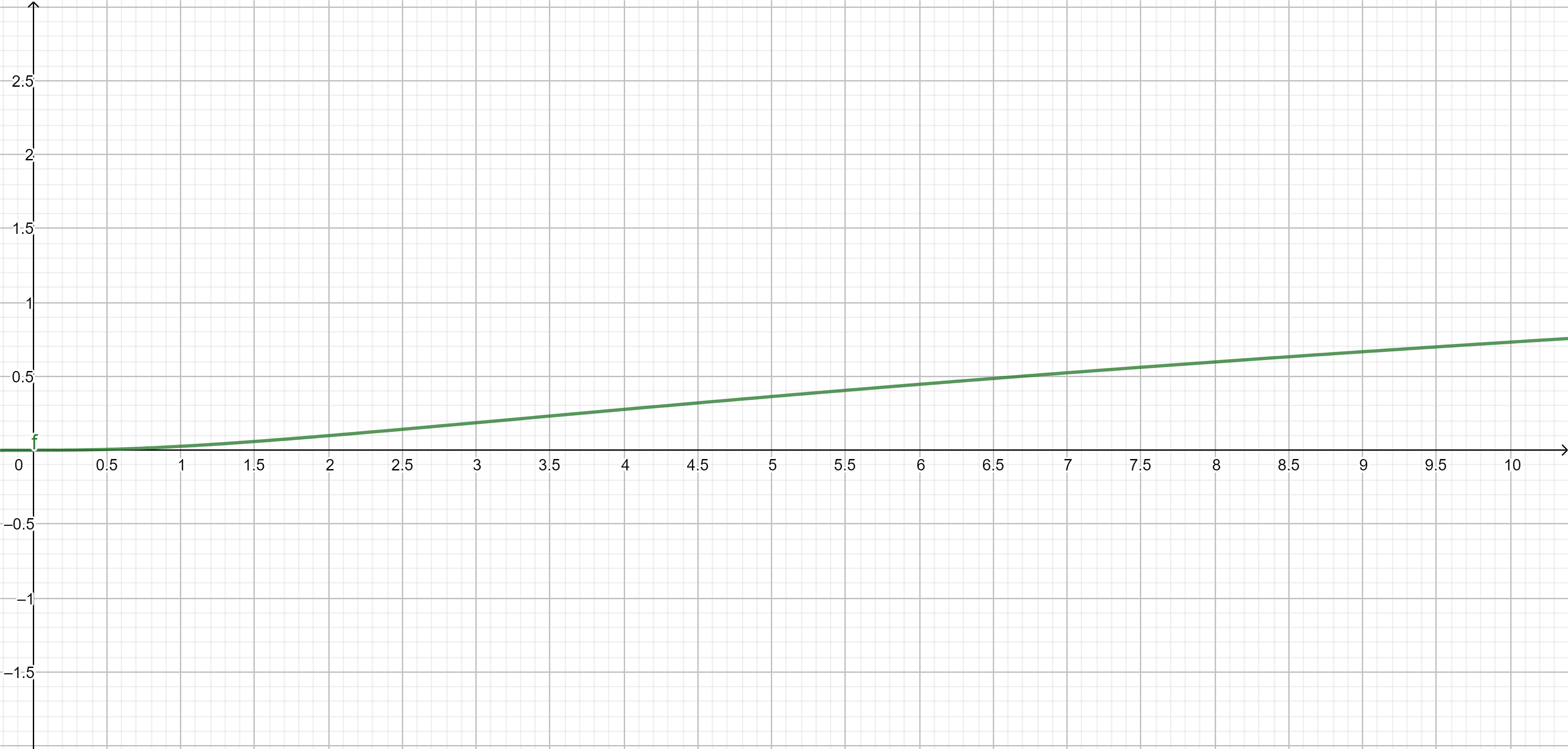
Proposition. For \(x>0\) one has \[\frac{x}{x+1}<\frac{2x}{x+2} \leq \log(x+1)<x.\]
Proof. Let \(f(x)=x-\log(1+x)\), then
\[f(0)=0,\] \[f'(0)=1-\frac{1}{x+1}>0\quad \iff\quad x>0\] thus \(f\) is increasing for \(x>0\). Hence \(f(x)>f(0) \text{ for }x>0\), so \[\log(1+x)<x.\]
We now consider \[h(x)=\log(1+x)-\frac{2x}{x+1}\quad \text{ for }\quad x>0.\] Note that \(h(0)=0\) and \[h'(x)=\frac{x^2}{(x+1)(x+2)^2}>0\quad \text{ for }\quad x>0.\] Thus \(h\) is increasing for \(x>0\) and \[h(x)>h(0)=0.\] Consequently \[\log(1+x)>\frac{2x}{x+2}>\frac{x}{x+1}\] for \(x>0\) as desired.$$\tag*{$\blacksquare$}$$
Graph of the function \(\log(x+1)-\frac{2x}{x+2}\)
Application
Application. \[\lim_{n \to \infty}\left(\frac{1}{n}+\frac{1}{n+1}+\ldots+\frac{1}{2n}\right)=\log 2.\]
Proof. Note that \[\frac{1}{n+1}<\log\left(1+\frac{1}{n}\right)<\frac{1}{n} \quad \text{ for }\quad n>1\] upon taking \({\color{blue}x=\frac{1}{n}}\) in \(\frac{x}{x+1}<\log(1+x)<x.\) Consequently \[\log\left(\frac{2n+1}{n}\right)<\frac{1}{n}+\frac{1}{n+1}+\ldots+\frac{1}{2n}<\log\left(\frac{2n}{n-1}\right).\] Thus \[\lim_{n \to \infty}\left(\frac{1}{n}+\frac{1}{n+1}+\ldots+\frac{1}{2n}\right)=\log 2.\qquad \tag*{$\blacksquare$}\]
Inequalities between weighted means
Theorem. If \(x_1,\ldots,x_k>0\) and \(\alpha_1,\ldots,\alpha_k>0\) and \(\sum_{j=1}^k\alpha_j=1\), then \[x_1^{\alpha_1}\cdot \ldots \cdot x_k^{\alpha_k} \leq \alpha_1x_1+\ldots+\alpha_kx_k.\]
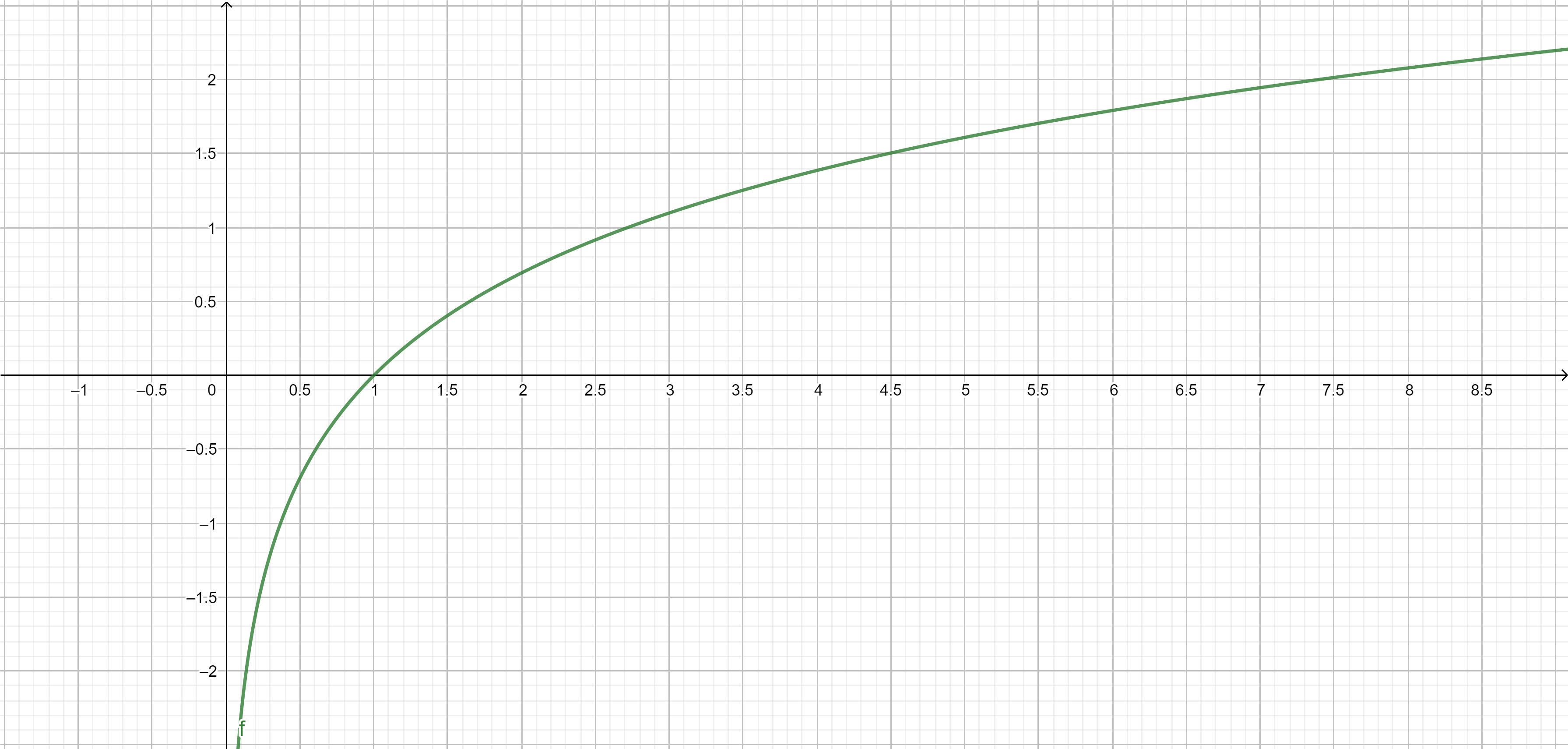
Proof. Let \(f(x)=\log(x)\) and note that \[f'(x)=\frac{1}{x}\quad \text{ and }\quad f''(x)=\frac{-1}{x^2}<0.\] Thus \(f''(x)<0\) for all \(x>0\) which means that \(f\) is concave. In other words, for all \(x_1,\ldots,x_k>0\) and \(\alpha_1,\ldots,\alpha_k>0\) obeying condition \(\alpha_1+\ldots+\alpha_k=1\), we have \[f(\alpha_1 x_1+\ldots+\alpha_k x_k) \geq \alpha_1 f(x_1)+\ldots+\alpha_k f(x_k).\]
Consequently, we have \[\log(x_1^{\alpha_1}\cdot \ldots \cdot x_k^{\alpha_k})=\sum_{j=1}^k \alpha_j \log(x_j) \leq \log\left(\sum_{j=1}^k\alpha_jx_j\right)\] if and only if \[\qquad \qquad \qquad x_1^{\alpha_1}\cdot \ldots \cdot x_k^{\alpha_k} \leq \sum_{j=1}^k \alpha_j x_j. \qquad \qquad \qquad \tag*{$\blacksquare$}\]
Corollary
Corollary. If \(p,q>0\) satisfy \(\frac{1}{p}+\frac{1}{q}=1\) and \(x,y>0\), then \[xy \leq \frac{1}{p}x^p+\frac{1}{q}y^q.\]
Proof. If suffices to apply the previous result with \(\alpha_1=\frac{1}{p}\), \(\alpha_2=\frac{1}{q}\) and \(x_1=x^p\), \(x_2=y^q\), then we obtain
\[xy=x_1^{1 / p}x_2^{1 / q} \leq \frac{1}{p}x_1+\frac{1}{q}x_2=\frac{1}{p}x^p+\frac{1}{q}y^q.\qquad \tag*{$\blacksquare$}\]
Remark. The inequality above is the key in the proof of Hölder’s inequality.
Applications of the power series
Fibonacci sequence
Fibonacci sequence. The Fibonacci sequence \((f_n)_{n \in \mathbb{N}}\) is defined by \[f_0=0, \ \ f_1=1,\] \[f_{n}=f_{n-1}+f_{n-2}\quad \text{ for }\quad n \geq 2.\]
Example. \[f_2=0+1=1,\] \[f_3=1+1=2,\] \[f_4=1+2=3,\] \[f_5=2+3=5,\] \[f_6=8, \ \ f_7=13, \ \ f_8=21.\]
Formula for \((f_n)_{n \in \mathbb{N}}\) - discussion 1/4
Consider \[\begin{aligned} {\color{red}\sum_{n=0}^{\infty}f_n x^n}&=x+\sum_{n=2}^{\infty}(f_{n-1}+f_{n-2})x^n \\& =x+x\sum_{n=2}^{\infty}f_{n-1}x^{n-1}+x^2\sum_{n=2}^{\infty}f_{n-2}x^{n-2}\\& =(x+x^2)\sum_{n=0}^{n=0}f_n x^n+x. \end{aligned}\]
Denoting \({\color{red}F(x)=\sum_{n=0}^{\infty}f_n x^n}\) we have \[F(x)=x+F(x)(x+x^2),\] so \[{\color{red}F(x)}={\color{blue}\frac{x}{1-x-x^2}}.\]
Formula for \((f_n)_{n \in \mathbb{N}}\) - discussion 2/4
Then \[1-x-x^2=-(x+\phi)(x+\psi),\] where \[\phi=\frac{1+\sqrt{5}}{2}, \quad \psi=\frac{1-\sqrt{5}}{2}.\]
Then \[F(x)=-\frac{x}{(x+\phi)(x+\psi)}=\frac{A}{x+\phi}+\frac{B}{x+\psi},\]
which is equivalent to \[-x=A(x+\psi)+B(x+\phi).\]
Hence \[A=\frac{-\phi}{\sqrt{5}}=\frac{1+\sqrt{5}}{2\sqrt{5}}, \quad B=\frac{\psi}{\sqrt{5}}=\frac{1-\sqrt{5}}{2\sqrt{5}}.\]
Formula for \((f_n)_{n \in \mathbb{N}}\) - discussion 3/4
So \[{\color{blue}F(x)=\frac{1}{\sqrt{5}}\left(\frac{\psi}{x+\psi}-\frac{\phi}{x+\phi}\right)}.\]
Recall that for \(|x|<1\) we have
\[\frac{1}{1-x}=\sum_{n=0}^{\infty}x^n.\]
Therefore \[\frac{\psi}{x+\psi}=\frac{1}{1+\frac{x}{\psi}}=\frac{1}{1-x\phi}=\sum_{n=0}^{\infty}\phi^n x^n,\] \[\frac{\phi}{x+\phi}=\sum_{n=0}^{\infty}\psi^nx^n.\]
Formula for \((f_n)_{n \in \mathbb{N}}\) - discussion 4/4
Finally, we have \[\begin{aligned} {\color{red}\sum_{n=0}^{\infty}f_nx^n}&{\color{red}=F(x)}\\&={\color{blue}\frac{x}{1-x-x^2}}=\frac{1}{\sqrt{5}}\left(\frac{\psi}{x+\psi}-\frac{\phi}{x+\phi}\right)\\&=\frac{1}{\sqrt{5}}\left(\sum_{n=0}^{\infty}\phi^n x^n-\sum_{n=0}^{\infty}\psi^nx^2\right)=\sum_{n=0}^{\infty}\frac{1}{\sqrt{5}}(\phi^n-\psi^n)x^n. \end{aligned}\]
Thus the formula for \((f_n)_{n \in \mathbb{N}}\) is given by
\[{\color{brown}f_n=\frac{1}{\sqrt{5}}\left(\left(\frac{1+\sqrt{5}}{2}\right)^n-\left(\frac{1-\sqrt{5}}{2}\right)^n\right)}.\].